Authored by Jude Comber 03.12.25
Social housing providers operate in an environment of rising tenant expectations, ageing housing stock, regulatory pressures, and funding constraints. Digital transformation offers significant opportunities to improve tenant experience, streamline processes, reduce costs, and enhance service resilience, but success requires a structured, incremental approach grounded in organisational realities.
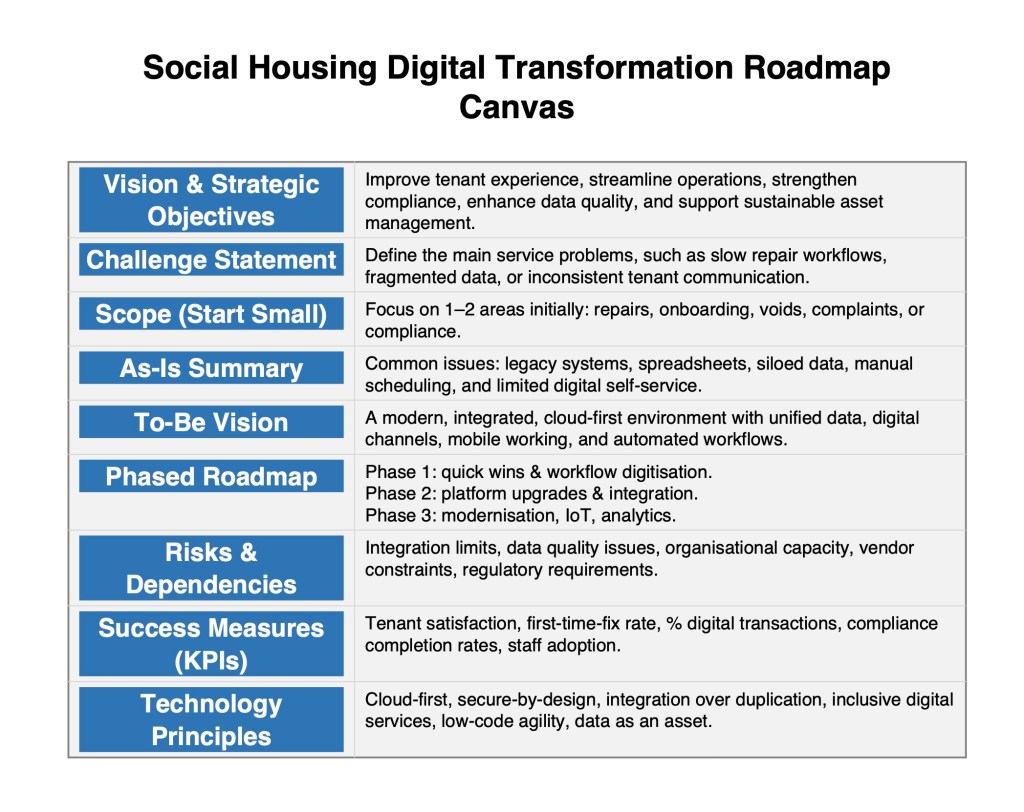
This article outlines a practical four-part framework for transformation in the social housing sector: framing and scoping the challenge, reviewing As-Is and To-Be architecture, building a roadmap with cost and timeline, and aligning technology with business strategy. It also provides practical resources to help organisations get started, especially when beginning small and iteratively.
Frame and Scope the Challenge
Social housing organisations often face challenges such as delayed repairs, siloed processes, ageing technology, manual data entry, inconsistent tenant communication, and compliance demands.
Effective transformation starts with clarity.
Key Framing Questions
- What tenant frustrations cause the most dissatisfaction?
(e.g., missed appointments, lack of repair updates, slow responses)
- What internal inefficiencies consume the most staff time?
(e.g., duplicate data entry, manual scheduling, spreadsheet-driven workflows)
- What regulatory requirements are we struggling to meet?
(e.g., damp & mould tracking, safety checks, asset compliance)
- What strategic priorities are our board and executives emphasizing?
(e.g., customer-first services, sustainable housing, efficiency savings)
Scope Definition
- Start with one or two service areas, e.g.:
repairs, voids, tenancy onboarding, customer contact, compliance.
- Define the pain points, desired outcomes, and KPIs such as:
- First-time-fix rate
- Percentage of repairs booked online
- Reduction of manual data entry
- Tenant satisfaction score
Outcome
A clear, tightly scoped challenge statement that makes change manageable and avoids overwhelming the organisation.
Review As-Is and To-Be Architecture
As-Is Architecture Review
Most social housing providers have a mix of legacy solutions and spreadsheets.
Key areas to document:
- Housing Management System (HMS): core data, limitations, integration gaps
- Repairs systems: contractor portals, job scheduling, workforce management
- Customer contact channels: call centre, email, webforms, portals
- Asset data systems: compliance checks, stock condition, IoT sensors
- Data quality & governance: duplication, inconsistency, manual patching
- Infrastructure: on-premise vs cloud, disaster recovery
- Skills & culture: digital literacy, change appetite
This step highlights constraints and identifies opportunities for quick wins.
To-Be Architecture
The target architecture should support:
- Unified tenant view across systems
- Integrated digital channels (portal, mobile, automated updates)
- Improved scheduling and repair automation
- Data-driven compliance management
- Cloud-based platforms for scalability and resilience
- Low-code workflows to iterate quickly without large IT overhead
Important:
The To-Be state should be modular, incremental, and achievable in phases, not a big-bang replacement of everything.
Roadmap Proposal with Cost & Timeline
A transformation roadmap in social housing should balance ambition with affordability. Start small, prove value, then scale.
Phase 1: Quick Wins (0–6 months)
Objectives: reduce friction, build confidence, show benefits.
Example – streamlined repair reporting
- Introduce online repair reporting or improve existing form usability
- Digitise simple workflows using low-code tools
- Clean and standardise core data (addresses, property references)
- Pilot mobile working for operatives
Cost: £10k–£50k depending on tooling
Value: immediate tenant and staff satisfaction improvements
Phase 2: Foundation Modernisation (6–18 months)
Objectives: strengthen systems, improve integration.
Examples:
- Introduce a customer portal or upgrade an ageing one
- Replace spreadsheets with case management tools
- Implement automated appointment reminders
- Introduce cloud-based document management
Phase 3: Strategic Transformation (18–36 months)
Objectives: deliver organisational-wide capability uplift.
Examples:
- Overhaul repairs platform or integrate contractor ecosystems
- Deploy IoT for damp/mould, legionella, and asset monitoring
- Introduce advanced analytics and predictive repairs
- Move legacy HMS to cloud version or new modular solution
Timeline Principles
- Work in small increments (4–8-week cycles)
- Demonstrate value at each step
- Adjust priorities based on tenant feedback and operational impact
Technology Alignment to Business Strategy
Digital initiatives must support key social housing strategic priorities such as:
- Tenant-centric service delivery
- Regulatory compliance and safety
- Operational efficiency & cost control
- Sustainability & asset longevity
- Workforce empowerment
Ways to Ensure Alignment
- Establish a Digital Steering Group linking IT, operations, and customer services
- Create service design maps to understand end-to-end tenant journeys
- Use data governance frameworks to ensure consistent asset and tenant data
- Adopt an enterprise architecture light approach to guide decisions
- Define a small set of architectural principles, such as:
- Cloud-first
- Integration over duplication
- Digital-by-default, but inclusive for vulnerable tenants
- Low-code for agility
Alignment ensures technology investment supports long-term housing provider objectives, not just IT upgrades.
Practical Resources:
Here are some curated tools and frameworks to help you begin small and iterate quickly:
Guidance & Frameworks
- UK Housing Ombudsman reports (patterns of service failure)
- Regulator of Social Housing’s Tenant Satisfaction Measures (TSM)
- National Housing Federation: digital transformation case studies
- Local Government Digital Service Standard
Tools for Iterative Delivery
- Low-code platforms
- Agile toolkits
- Service design and journey mapping
My Conclusions
Digital transformation in social housing does not require a massive upfront overhaul. By framing the challenge clearly, understanding the current and desired architecture, building an incremental roadmap, and aligning technology with strategic priorities, housing providers can make meaningful progress while managing risk and cost.
Starting small, one service area, one workflow, one data fix, allows organisations to learn, adapt, and demonstrate success, laying the foundation for long-term, sustainable transformation.

 Digital Housing Change
Leave a comment